

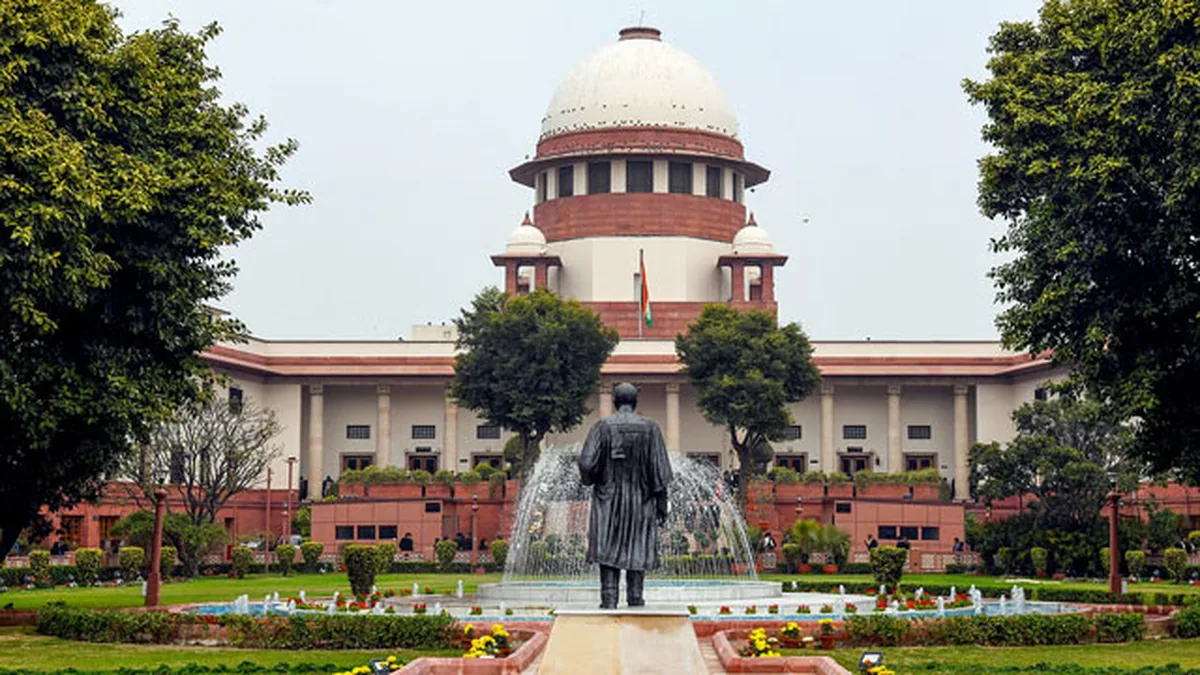
The Supreme Court of India, in a significant ruling delivered on Thursday, November 5, from New Delhi, has clarified the precise moment the constitutional 24-hour deadline for producing an arrested individual before a magistrate begins. This pivotal decision aims to curb arbitrary detention by law enforcement agencies, asserting that the clock starts ticking the instant a person's liberty is curtailed, not when police formally record the arrest.
A bench comprising Justices Ujjal Bhuyan and Atul S Chandurkar unequivocally stated that no artificial distinction exists between 'arrest' and 'detention' when interpreting Article 22(2) of the Constitution. The court emphasized that any interpretation excluding the period of detention prior to formal arrest would fundamentally undermine the constitutional safeguard against unlawful confinement. This view, they observed, directly contradicts both Article 22(2) and Section 56 of the BNSS. The only time permissible for exclusion from this 24-hour period is the reasonable travel time from the point of arrest to the magistrate's court. Crucially, time spent on inquiry, investigation, search, or seizure before the formal arrest cannot be omitted from this calculation. Even individuals detained solely for search and seizure operations must be presented before a magistrate within the stipulated constitutional timeframe.
This landmark clarification stems from appeals filed by four individuals arrested in a narcotics case under the Narcotic Drugs and Psychotropic Substances (NDPS) Act in Tripura. These persons were initially detained on September 29, 2025, around 2 pm, during search and seizure operations involving 11.03 kg of yaba tablets. However, their formal arrests were not recorded until 11 am the following day. The Supreme Court decisively held that the 24-hour period commenced at their initial detention on September 29. Their subsequent custody without judicial oversight for approximately 18 hours beyond the permissible limit constituted a clear violation of Article 22(2), mandating their immediate release. The bench also addressed the Tripura High Court's prior rejection of their bail pleas.
Article 22(2) dictates that every arrested and detained person must appear before the nearest magistrate within 24 hours, excluding travel time, and prohibits further detention without a magistrate's authority. The Supreme Court explicitly disapproved of contrary interpretations previously adopted by the Orissa High Court in the Aryaman Pattanaik case, the Kerala High Court in the Arun K Thomas case, and the Madras High Court in the Kannan case. Beyond the 24-hour rule, the court underscored that merely complying with this deadline does not automatically render every period of detention reasonable. Detaining authorities bear the responsibility to ensure custody is always justified and does not extend beyond what is necessary, even within the constitutional limit. Judicial magistrates have been directed to independently verify adherence to these constitutional requirements.
Image: daijiworld.com
📰 Source: Daijiworld