Desi Batman rode a buffalo to 16 million views. The AI was not the secret.
Batman, a buffalo and a 1999 song
Last week my feed was full of Batman. Not the Gotham one.
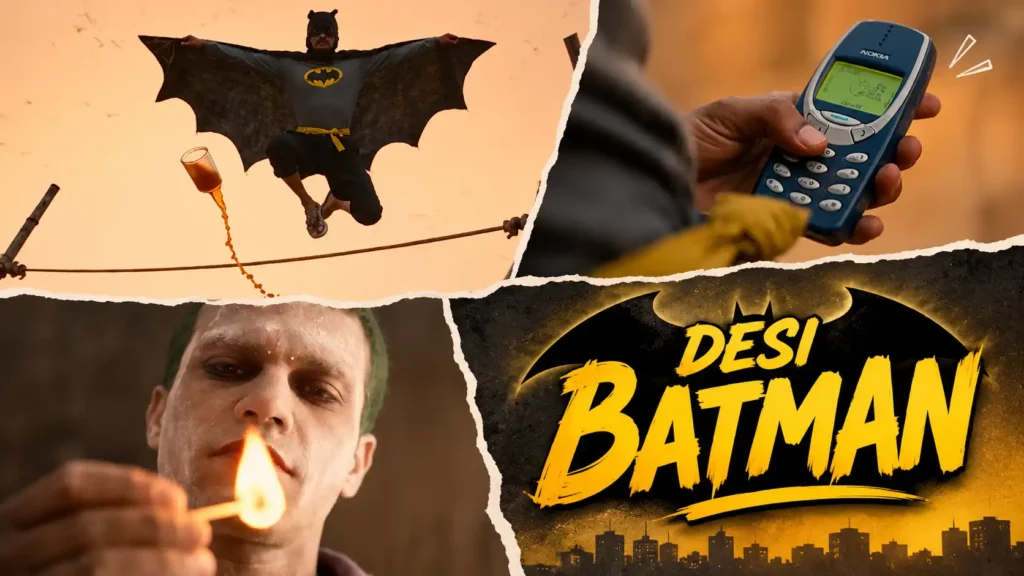
This Batman brushes his teeth next to a village railway track. He sees a poster about a missing boy. Then the Joker pulls up in an autorickshaw, offers the boy a lollipop and takes him. Batman goes home, puts on the suit, and rides out on a buffalo. There is a fight. The boy is saved. The whole thing plays to a remix of Madhuri Dixit’s “Saajan Saajan” from the 1999 film Arzoo.
I laughed. Then I watched it again, this time as a creative person. Because it is not just funny. It is well made.
The series is called Desi Batman. It was made by Sujal Jaiswar, an AI generalist based in Bengaluru. That one video has crossed 16 million views on Instagram. Sujal says the series brought him 100K followers and more than 25 million views in two weeks. He also says it is fully AI, made in Higgsfield’s Cinema Studio.
People are calling it better than big-budget films. Amazon Music India even joined in with its own post. So I want to look at what actually made it work, and what any of us would need to make something like it.
Why it worked
The tools Sujal used are open to anyone. Thousands of people use them every day. Most of what they make is forgotten in a scroll. So the tool is not the reason. These are.
1. One clear twist. A global superhero in a world we all know: chai stalls, autos, railway tracks, a buffalo instead of a Batmobile. You get the joke in the first second. Nobody needs to explain it.
2. A real story. Missing child. Villain. Hero suits up. Fight. Rescue. That is a full story in under a minute. Most AI videos are pretty shots with no plot. This one gives you a reason to stay till the end.
3. It is directed like a film. Look at the comments. People are not only saying “funny”. They are talking about framing, camera angles, camera movement, transitions, sound effects and score. Those are director’s choices. The AI does not make them for you.
4. Music with memory. A 1999 Bollywood song over a dark superhero scene is a second joke on top of the first. It also gave people a sound they wanted to reuse. That is how it travelled beyond his own page.
5. A series, not a one-off. Same Batman. Same Joker. New episode. People come back for characters they know. He did not make a video. He made a small franchise.
6. Years of taste behind it. Sujal has been making content for about five years. He comes from marketing and production. The “overnight” hit sits on top of a long run of practice.
What you need to make something like this
If you want to make an AI film that people actually watch, here is what I would prepare. Most of it happens before you type a single prompt.
- The idea in one line. Something familiar in a place you don’t expect it. If you can’t say it in one line, it is not ready.
- A short script and a shot list. Setup, problem, low point, payoff. Then number every shot, one line each. This is your plan for the whole film.
- A character sheet. Front, side and back views for each character, plus outfit and props. Use it as the reference for every shot. Characters changing face from shot to shot is where most AI films fall apart.
- A look sheet. Colour palette, light, grain, era and lens feel. Decide once and reuse it. In my own launch film work I use public image and video models with a locked style prompt and reference images. It is the only way I have found to keep every shot looking like the same film.
- Real local detail. The right props, signs, roads and habits. Your audience knows these by heart. Get them wrong and they notice right away.
- Camera choices for every shot. Shot size, angle, lens and movement. Wide to show the place, mid for the action, close-up for feeling, a cutaway for detail like the poster or the lollipop. Don’t let the model choose.
- Patience with takes. Generate short clips of 5 to 10 seconds and pick the best one. Expect to throw away a lot.
- The edit. Hook in the first two seconds. Cut on the music. Keep it tight.
- Sound. Footsteps, crowd, wind, hits. Sound design is half of what makes something feel cinematic.
- A plan to release it. Vertical format, captions, a strong cover frame, and numbered parts so people follow the series.
The real lesson
AI has made production cheap. It has not made taste cheap.
The camera, the lights and the location are now a few clicks away for anyone. What is still rare is knowing what story to tell, where to put the camera, when to cut, and which old song will make a whole country smile. That is the job of a creative director. It always was.
So if you lead a creative team, don’t ask “which AI tool should we use?” first. Ask “what is the idea, and who is directing it?” The tool comes after.
Hats off to Sujal Jaiswar for showing it so well, and with a buffalo.
What do you think made it work for you? The story, the setting or the song?