

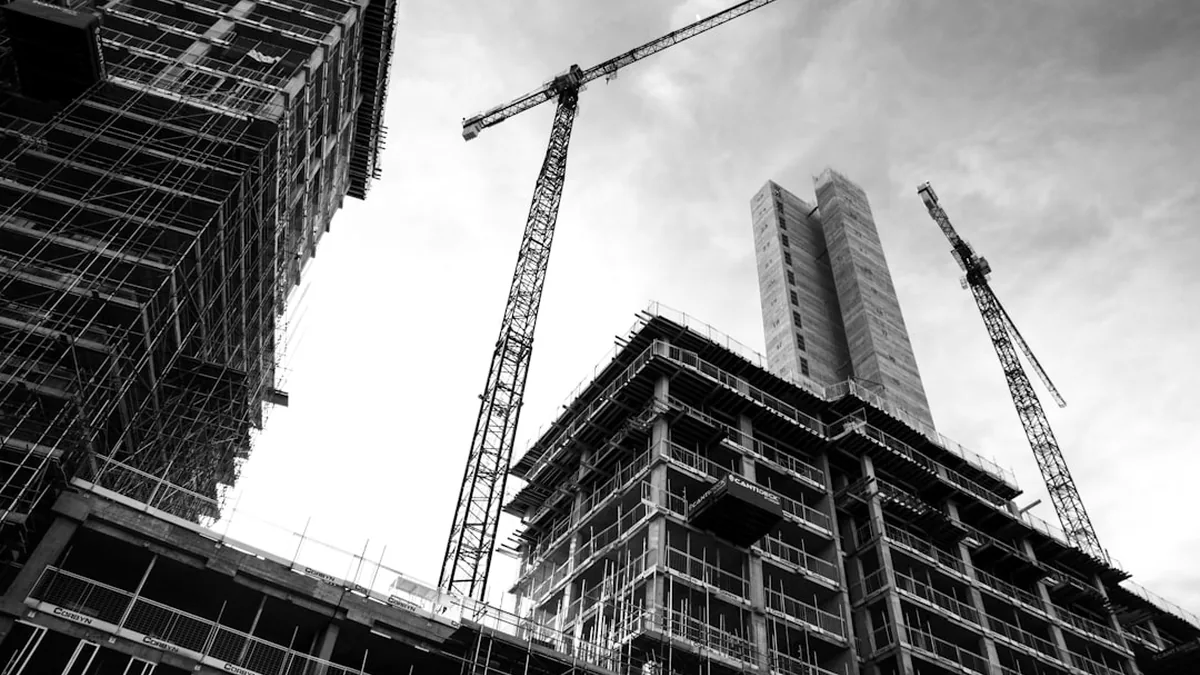
A staggering amount of new construction, equivalent to an entire New York City built every month, is emerging worldwide to meet vital infrastructure demands. While providing essential roofs, classrooms, and workspaces, this rapid urbanisation generates immense greenhouse gas emissions. New research, using Australia's office building sector as a key case study, highlights the critical climate challenge posed by this unprecedented building spree.
The global need for new structures is immense. Australia's National Housing Accord, for instance, aims for 1.2 million new, well-located homes between 2024 and 2029. Yet, this effort is dwarfed by the 96,000 new and affordable homes required globally every single day, addressing a crisis where hundreds of millions endure homelessness or harmful living conditions. This expansion, however, carries a significant environmental cost, largely due to 'embodied carbon'—emissions released from materials and construction processes.
To grasp the scale, constructing just one square metre of floor space releases approximately half a tonne of greenhouse gases. Projecting this to a New York City-sized area built monthly underscores the magnitude of the problem. The study specifically examined Australia's office building trends, noting the country currently has about 170 million square metres of office space, with a further 100 million projected by 2049.
Modelling revealed these Australian office buildings are set to release 138 million tonnes of greenhouse gas emissions between 2024 and 2049. This figure is comparable to the annual emissions of 36 coal-fired power stations and represents only a fraction of Australia's total urban emissions, as offices constitute just 20 per cent of all commercial buildings.
Surprisingly, operating emissions (from heating, lighting, cooling) are projected to drop from 85 per cent of the total in 2024 to just 15 per cent by 2049, thanks to Australia's energy sector decarbonisation and shift towards renewables. However, annual embodied emissions are expected to remain at similar levels. Reducing embodied carbon proves more difficult, as many material supply chains, such as cement manufacturing which accounts for 8 per cent of global carbon dioxide emissions, still heavily rely on fossil fuels and
Image for illustration purposes only
📰 Source: Siasat Gulf