

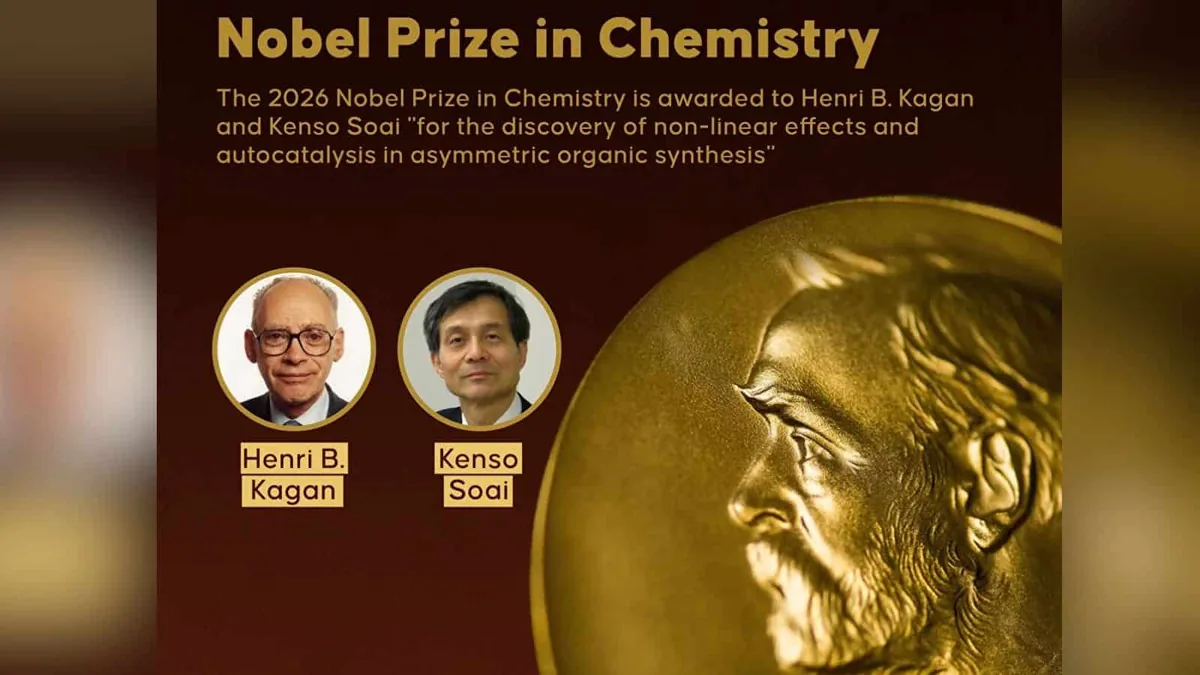
Scientists Henri B. Kagan of France and Kenso Soai of Japan were jointly awarded the Nobel Prize in Chemistry this Wednesday in Stockholm. The prestigious recognition from The Royal Swedish Academy of Sciences honors their groundbreaking work in unraveling the perplexing mirror images found in molecules, a fundamental discovery that has revolutionized drug development and significantly advanced modern medicine.
Many chemical compounds exist in two forms, structurally identical but mirror images of each other, much like a person's left and right hands. Crucially, these alternate versions can possess vastly different properties; for instance, one molecular form of carvone smells distinctly of mint, while its mirrored counterpart carries the aroma of caraway. When developing pharmaceuticals, scientists require precise control over which specific mirror image they obtain, ensuring a drug effectively targets a disease without unwanted side effects.
Kagan and Soai's pivotal research provided the chemical community with methods to achieve this selectivity. Dr. Kagan, affiliated with Université Paris-Sud, laid the groundwork in the 1980s by demonstrating a viable path to design reactions that favored the production of one molecular form over the other. Years later, Dr. Soai, from Tokyo University of Science, perfected this intricate process. He notably engineered the first chemical reaction capable of efficiently yielding only a single mirror image of a molecule, a technique now widely recognized as the "Soai reaction."
Rigoberto Hernandez, president of the American Chemical Society, emphasized the profound impact of their findings, stating, "The medicines we have today would not be possible without this chemistry." Peter Somfai, a member of the Nobel Committee for Chemistry, described their achievement as a "feat never previously achieved by anyone 'other than life itself,'" calling the Soai reaction "probably the coolest experiment in organic chemistry." He added that this understanding serves as a foundational "tool" for developing catalysts across virtually all modern medicines.
The significance extends beyond drug development. Even biological systems exhibit this preference; DNA spirals to the right, and human proteins are predominantly constructed from left-handed building blocks. Chemist Holden Thorp, editor-in-chief of the journal Science, highlighted that deciphering these molecular mirror images also deepens scientists' comprehension of life's fundamental chemical architecture.
Upon receiving the news while grocery shopping, the 76-year-old Professor Soai expressed his excitement to the Nobel committee and journalists, calling it "one of the most exciting days in my life." Professor Kagan is 95 years old. Neither of their respective universities immediately responded to inquiries regarding the announcement.
Image: siasat.com
📰 Source: Siasat Gulf